Artificial intelligence usually communicates with us through words. Ask ChatGPT, Claude or Gemini a question and the model generally produces text. That works well when a person needs an explanation, article, email, summary or conversation. Software automation often needs something different: a decision.
The essentials in 30 seconds
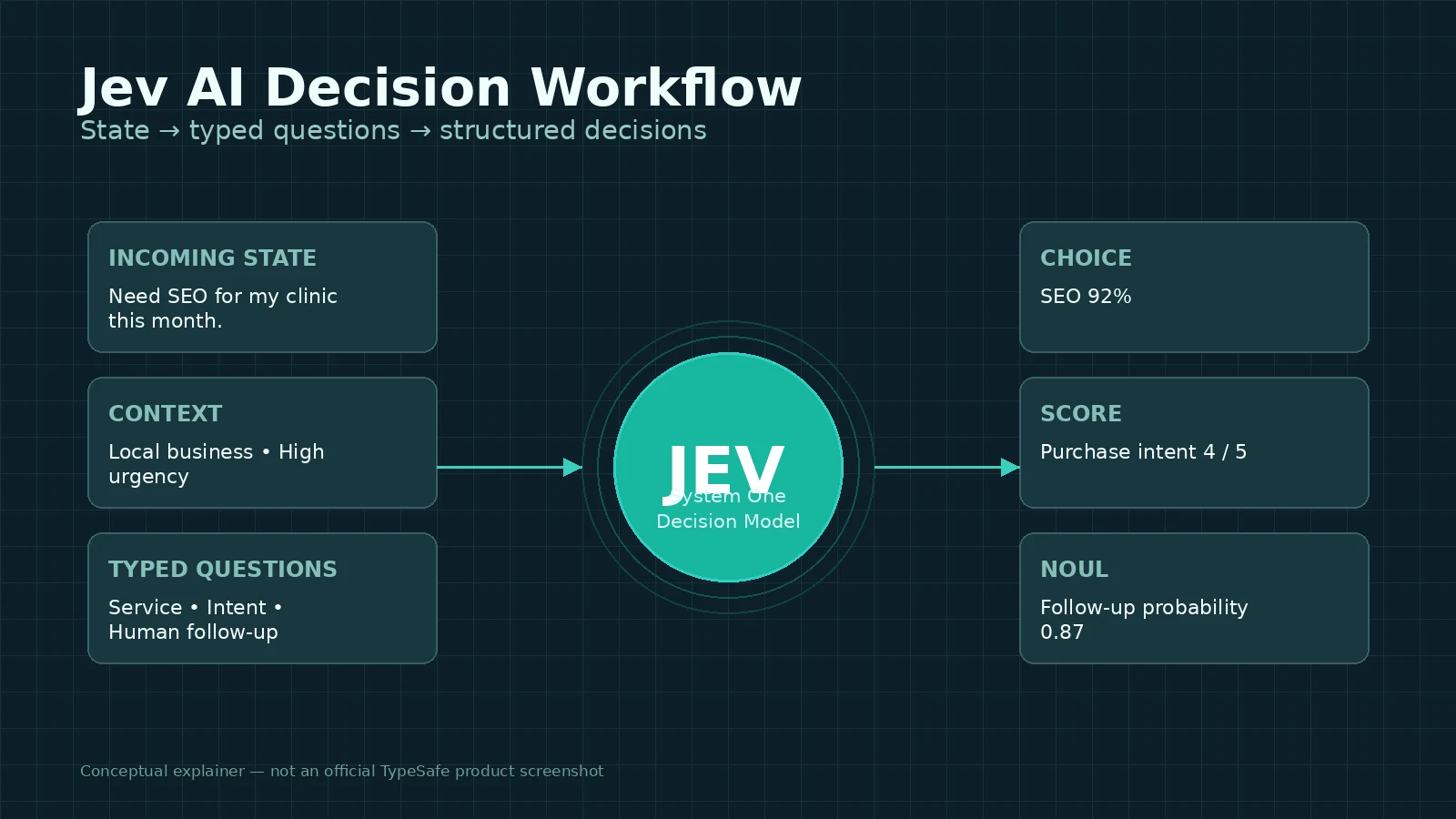
Questions like “Should this lead go to sales?”, “Which department should receive this ticket?”, or “Does this request need human review?” are closer to Jev's intended role than open-ended content generation.
What Is Jev AI?
Jev AI is a decision-focused artificial intelligence model developed by TypeSafe AI that converts unstructured information into structured, typed decisions.
TypeSafe describes Jev as its first public System One model. Rather than behaving primarily as a chatbot, Jev is designed to sit inside software and answer narrowly defined questions in a machine-friendly format.
General-purpose LLMs primarily generate text; Jev primarily returns predefined decisions with probabilities.
Who created Jev AI?
Jev was created by TypeSafe AI. TypeSafe publicly introduced its System One architecture and Jev in September 2026. The company also describes a training method called Reinforcement Learning for Calibrated Decisions (RLCD).
What Is a System One Model?
TypeSafe uses the term System One model for AI designed around fast, structured judgments. The product framing is inspired by the distinction between fast intuitive judgment and slower deliberate reasoning.
In practice, the useful takeaway for developers is simple: a System One task is usually a focused decision, not an open-ended reasoning problem.
| Good fit | Less suitable |
|---|---|
| Which department should receive this request? | Develop a complete international expansion strategy and explain every trade-off. |
| How urgent is this lead? | Write a 2,000-word campaign proposal. |
| Does this output require human review? | Brainstorm a creative brand identity. |
How Does Jev AI Work?
1. Provide the state
The state is the information Jev needs to evaluate. It might be a customer message, lead information, structured JSON, a product description, an application state or another text representation.
2. Define the question
The developer defines the type of answer required rather than requesting unrestricted conversational output.
3. Jev evaluates the state
Multiple typed questions can be evaluated against the same state, allowing one input to produce several structured judgments.
4. Receive structured answers
Results can include categories, ordered scores, probabilities or confidence information.
5. Let application logic decide what happens next
The application can define thresholds such as:
- High confidence → automate
- Medium confidence → perform secondary verification
- Low confidence → send to human review
From unstructured state to software action
Jev handles a narrow judgment; your application keeps control of the final action.
Choice, Score and Noul Explained
Choice
Select one option from a known set. Useful for routing and classification.
Score
Rate something against an ordered rubric instead of producing free-form commentary.
High purchase intent
Noul
Return a probability that a statement is true. Your application chooses the threshold.
Needs human follow-up
Choice
Select one option from predefined alternatives.
Example: SEO / Google Ads / Meta Ads / Website Design.
Score
Evaluate something against an ordered scale or rubric.
Example: Purchase intent from 0 to 4.
Noul
Return a probability between 0 and 1 for whether a statement is true.
Example: “Does this enquiry need human follow-up?”
Combined workflow
Several independent questions can be applied to the same state.
Example: category + urgency + spam risk + human-review probability.
Jev-style Decision Lab
Choose a sample message to see how a structured decision layer can classify the same state across multiple questions.
Incoming message
Structured output
High confidenceKey Features of Jev AI
Typed outputs
Jev's answer format is defined before inference, giving software a known output structure instead of an unpredictable paragraph.
Probability-based decisions
Probability information can help teams build confidence-aware automation and route uncertain decisions for secondary review.
Multiple questions per state
A single lead, message or document can be evaluated across several independent decision dimensions.
Designed for automation
The model is positioned around machine-consumable intelligence such as classification, scoring, routing and verification.
API-first usage
TypeSafe documents a REST API and Python SDK, making Jev suitable for integration inside software products and workflows.
Parallel decision architecture
TypeSafe describes Jev as producing structured decisions in parallel rather than generating unrestricted prose token by token. Performance claims should still be tested on your own workloads.
How to Use Jev AI
- Open the TypeSafe Playground. Start with the official interface before writing production code.
- Add your state. Paste the information Jev should evaluate.
- Create Choice, Score or Noul questions.
- Review the probabilities and confidence.
- Test with realistic edge cases.
- Define automation thresholds.
- Move the tested workflow into your application through the API.
Jev AI API Example
A simplified request structure could look like this:
{
  "state": "Customer message or application state",
  "model": "jev-latest",
  "questions": {
    "category": {
      "type": "choice",
      "instructions": "Which category best describes this request?",
      "criteria": {
        "seo": "Search engine optimization",
        "ads": "Paid advertising",
        "website": "Website development"
      }
    }
  }
}
Always confirm current endpoint names, model identifiers, request formats and limits in TypeSafe's official documentation before deploying production code.
Jev AI Use Cases
Customer support routing
- Billing or technical issue?
- Urgent or normal?
- Human review required?
- Customer frustration level?
Lead qualification
A lead-management system could classify requested service, purchase intent, urgency and spam likelihood before routing the lead.
AI-agent routing
Jev can potentially act as a decision layer that chooses which tool, workflow or model should run next.
Verification and guardrails
Structured probability checks can help decide whether an automated result should continue, receive another verification step or move to a human.
Jev AI for Digital Marketing
Jev's most natural digital-marketing applications involve classification, scoring and routing, not content creation.
| Marketing task | Possible Jev role |
|---|---|
| Lead generation | Classify service interest, urgency and buying intent |
| Social messages | Route complaint, enquiry, feedback or spam |
| SEO workflow | Classify intent, content type or review priority |
| Campaign operations | Categorize assets by objective, stage or audience |
Lead qualification without generating a paragraph
A narrow decision layer can classify an enquiry before your CRM or generative AI takes over.
1. Website Enquiry
“Need SEO for my dental clinic. Can someone call tomorrow?”
2. Jev Decisions
3. CRM Action
Priority SEO lead → assign sales owner → schedule fast follow-up.
Jev AI Pricing
At the time this article was prepared, TypeSafe publicly listed Jev at: $0.042 per million input tokens, equivalent to $42 per billion input tokens, with output not metered for billing.
Official source: TypeSafe AI pricing. Verify current pricing before publishing or budgeting.
| Pricing item | Published information |
|---|---|
| Input tokens | $0.042 per 1 million |
| 1 billion input tokens | $42 |
| Output tokens | Not metered / free for billing |
Where Jev can sit beside a generative LLM
Use structured decisions for control flow and generative models for communication or open-ended reasoning.
Choice • Score • Noul
Route the workflow with probability-aware decisions.
Jev AI vs ChatGPT and General-Purpose LLMs
| Capability | Jev AI | General-purpose LLM |
|---|---|---|
| Free-form writing | Not designed for it | Strong fit |
| Conversation | Not primary purpose | Strong fit |
| Structured classification | Core purpose | Possible |
| Scoring | Native | Possible |
| Probability-oriented decisions | Core design | Varies |
| Long explanations | No | Yes |
| Creative ideation | Poor fit | Strong fit |
| Decision automation | Core focus | Possible |
Jev decides. A generative LLM communicates.
Jev AI Pros and Cons
Pros
- Structured, predictable output types
- Probability-based decisions
- Useful for repetitive classification and routing
- Several decisions can be evaluated against one state
- API-oriented product design
- Low published input-token price
Cons / Limitations
- Not a replacement for creative or long-form generative AI
- Question and rubric design still matter
- A valid output can still be the wrong decision
- Thresholds require testing
- Some problems still require multistep reasoning
- Young product category with a shorter production track record
Does Jev AI Hallucinate?
TypeSafe uses strong language around constrained or type-safe outputs, but that should not be interpreted as “Jev can never make a wrong decision.”
A model can stay perfectly within the allowed schema and still select an incorrect category. This distinction matters:
- Output/schema failure: constrained by the architecture.
- Decision error: still possible and should be measured.
High-impact workflows should include realistic validation, calibrated thresholds and human escalation.
Jev AI Alternatives
General-purpose LLMs with structured output
Consider these when the same workflow also needs explanation, generation or more complex reasoning.
Traditional classification models
Useful when labels are stable, training data is available and the task is narrowly defined.
Rules-based software
If the decision can be expressed deterministically, ordinary code may be more reliable and easier to audit.
Human review
Human judgment remains important for ambiguous or high-impact decisions, especially where mistakes have meaningful consequences.
| Approach | Main purpose | Consider when |
|---|---|---|
| Jev | Typed probabilistic decisions | Repeated structured automation |
| General LLM | Generation + reasoning | You need explanations or content |
| Custom classifier | Fixed-label prediction | Stable task + training data |
| Rules | Deterministic logic | The logic can be exactly coded |
| Human review | Context-rich judgment | Ambiguous or high-impact decisions |
Is Jev AI Worth Using?
Jev is worth evaluating when your application repeatedly needs to turn ambiguous text or application state into a known set of decisions such as routing, qualification, prioritization, scoring, verification or intent classification.
It is less relevant when the primary requirement is creative writing, unrestricted conversation, brainstorming, complex explanation or long-form reasoning.
Frequently Asked Questions About Jev AI
What is Jev AI?
Jev AI is TypeSafe AI's System One model for structured decisions. It evaluates state against typed questions and returns choices, scores or probabilities rather than unrestricted prose.
Who created Jev AI?
Jev was created by TypeSafe AI and publicly introduced in September 2026.
Is Jev AI an LLM?
TypeSafe positions Jev as a System One model rather than a traditional generative LLM. Its focus is structured decisions rather than free-form text generation.
What can Jev AI do?
It can classify, score and evaluate predefined questions against supplied state, which makes it suitable for routing, prioritization, qualification and automated decision workflows.
What are Choice, Score and Noul?
Choice selects an option, Score rates something against an ordered rubric, and Noul returns a probability from 0 to 1 for whether a statement is true.
How much does Jev AI cost?
At the time this article was prepared, TypeSafe listed $0.042 per million input tokens and $42 per billion input tokens, with output not metered for billing. Always verify current pricing before purchase.
Does Jev AI generate text?
Free-form text generation is not its primary output mechanism. Jev is designed to return structured values defined by the developer's typed questions.
Can Jev AI replace ChatGPT?
Not for every task. Generative chat models are better suited to writing, explanation and open-ended reasoning, while Jev focuses on structured decisions.
Does Jev AI have an API?
Yes. TypeSafe documents a System One REST API and developer tooling for programmatic integration.
Can Jev AI make mistakes?
Yes. Constrained output formats do not guarantee that every underlying judgment is correct. Teams should test accuracy and calibration on representative data.
Final Takeaway
Jev AI represents a different direction in artificial intelligence. Instead of focusing on producing a better paragraph, it focuses on producing a structured decision that software can consume.
That makes it especially relevant to developers building automation, lead qualification, routing, classification, scoring, verification and agent workflows. But it should not be misunderstood as a universal replacement for generative AI.
The practical opportunity is often to combine both: use a decision model where software needs structured judgment, and use a generative model where a human needs explanation, content or conversation.
Exploring AI Automation for Your Business?
Digitalford helps businesses combine websites, SEO, advertising and practical AI automation into digital workflows designed around real business needs.
Contact DigitalfordOfficial Sources
- TypeSafe AI — Official Website
- TypeSafe AI — Official Documentation
- TypeSafe AI — Quick Start
- Introducing System One Models & Jev
- TypeSafe AI — Privacy Policy
Last updated: September 28, 2026. Jev is a recently introduced product, so pricing, availability, model identifiers and product capabilities may change. Verify current technical and commercial details using TypeSafe AI's official sources before implementation.